CHANGING MINDS, LAWS & LIVES CAMPAIGN

About DRCNetStop the Drug War (DRCNet) is an international organization working for an end to drug prohibition worldwide and for interim policy reform in US drug laws and criminal justice system. Read more about DRCNet.

Make a Donation

Want to stop the drug war? One way to help is to make a generous donation -- member support makes up a critical portion of our budget, and we can't do it without you!

some organizations DRCNet played a role in starting:


Drug War Topics

Death Penalty

ENCOD Statement to the Malaysian government

Brussels, 4 March 2010
To: Yang Amat Berhormat Dato’ Sri Mohd Najib Bin Tun Abdul Razak
Prime Minister of Malaysia

Dear Excellency,

Today we write to you as European citizens concerned with the impact of global drug policies, with an urgent request. We believe the death sentence that is applied to drug law offenders in Malaysia is an inappropriate measure, and would like to offer you our collaboration in identifying better solutions to the drug problems in your country.

With certain regularity, reports appear in the Malaysian press on people being sentenced to death for the possession of illegal drugs, including cannabis. The exact number of those who are actually brought to death remains unknown. Human rights organisations estimate that currently some 300 convicted prisoners await execution on death row, most of them for drug-related offences.

These sentences clearly violate international standards for a fair trial. The presumption of guilt and the mandatory death sentence in drug cases places the charge on the accused to prove his or her innocence and leaves a judge with no discretion over the sentence. Competent legal assistance is unavailable to many of those people, leaving them with little capacity to mount a defence at any stage of the proceedings.

UN human rights bodies have concluded that drug offences fail to meet the condition of “most serious crime”, under which the death penalty is allowed as an “exceptional measure”.

We are aware of the argument that drugs cause problems in Malaysian society. However, we doubt that these problems will be solved by harsh punishments, let alone executions of drug offenders.

Malaysia, like any other country in the world, is not and never will be 100 % drug-free. As long as people in Malaysia want to consume drugs, other people will continue to supply them.

Because of the fact that drugs are prohibited, drug trafficking is the core business of criminal organizations that in most cases operate internationally. The people who are occasionally caught by authorities with relatively small amounts do not have major responsibilities in this business. Killing them will not scare the drug gangs away. On the contrary: thanks to these harsh punishments, the leaders in the drug business can continue to justify extraordinary high prices for their goods,. Thus it maintains a vicious circle of violence and danger.

On the other hand, it is important to make a serious assessment of the problems that drugs may or may not cause. Cannabis for instance is a plant, a natural product, a non-lethal substance. Its consumption has been widespread around the world for thousands of years among many different cultures and people. All these people do not use cannabis because it endangers their health or wellbeing, but rather because they experience the opposite. According to increasing amounts of scientific evidence, the so-called dangerousness of cannabis has been largely exaggerated and driven by moral in stead of rational considerations.

The prohibition of cannabis was installed and promoted worldwide by Western countries, especially the USA, during a period in which they dominated the world. Meanwhile, in most European countries, cannabis possession for personal consumption is not penalised anymore. In a growing number of states in the USA, major law changes are taking place that legally regulate the cultivation and distribution of cannabis to adults for medicinal purposes.

It would be extremely sad to see Malaysia continue executing people found in possession of cannabis, while the countries that have installed its prohibition have come to the insight that this is a useful substance whose consumption can be perfectly integrated in society.

In Europe, during the past decades, we have been able to compare the results of different, sometimes opposing drug policies in societies that are similar in demographical, material and socio-cultural development. The conclusion is that drug policies, whether they are repressive or flexible, have a very minor impact on the drug phenomenon itself. In countries where authorities are relatively tolerant, the use of drugs may be lower than in neighboring countries where policies are more repressive.

Another conclusion is that drugs-related harms can only be reduced by effective social and health policies. Innovative strategies for reaching out to the affected population and reducing the harms related to drug use are needed. The harsh implementation of drug law enforcement is an impediment to the introduction of these strategies.

For these reasons, we are convinced that the death penalty is actually counterproductive to efforts to reduce the harm caused by drugs.

We call upon your wisdom to apply principles of sound governance and let Malaysia join the majority of nations by declaring a moratorium on executions with a view to total abolition of all death sentences for drug offenses, as called for by the United Nations.

We offer you our kind co-operation in transmitting knowledge and experience of public health policies that have proven effective in addressing drug-related problems.

Sincerely yours,

Marisa Felicissimo, Fredrick Polak, Jorge Roque and Antonio Escobar
Members of the Steering Committee of the European Coalition for Just and Effective Drug Policies

Middle East: Hamas Adopts Tough New Drug Laws, Includes Death Penalty for Dealers

The Hamas government running the Gaza Strip has adopted a law that allows for the death penalty for drug dealing. The move came Monday with a Hamas decision to cancel Israeli military laws on drugs and replace them with Egyptian drug laws.

"The government has approved a decision to cancel the Zionist (Israeli) military law with regard to drugs and enact Egyptian law 19 of 1962," Gaza Attorney General Mohammed Abed said in a statement. "The latter law is more comprehensive in terms of crime and criminals and the penalties more advanced, including life sentences and execution. The Zionist law included light punishments that encouraged rather than deterred those who take and trade in drugs, and there is no objective, national or moral justification for continuing to apply it," Abed said.

The Egyptian drug law will remain in effect until the Palestinian parliament passes a new drug law. But the parliament has only met rarely since elections in 2006.

The Gaza Strip was administered by Egypt from 1948 to 1967, when Israel seized the territory, along with several others, during the Six-Day War. Israel withdrew its soldiers and settlers from the territory in 2005, when it was under the control of the secular Fatah Party of Palestinian President Mahmud Abbas. But Hamas unexpectedly defeated Fatah in Gaza elections in the 2006 elections and consolidated its power in a bloody factional struggle with Fatah the following year.

Because of an ongoing Israeli blockade, most goods, including illicit ones, imported into Gaza are smuggled in, primarily through a network of tunnels on the Egyptian border. But Hamas has cracked down on drug trafficking and drug traffickers, claiming more than 100 arrests, and the seizure of dozens of kilograms of drugs, mostly marijuana.

Asia: Drug Users Form Regional Drug User Organization

In a meeting in Bangkok last weekend, more than two dozen drug users from nine different countries came together to put the finishing touches on the creation of a new drug user advocacy organization, the Asian Network of People who Use Drugs (ANPUD). The Bangkok meeting was the culmination of a two-year process began at a meeting of the International Congress on AIDS in Asia and the Pacific in Colombo, Sri Lanka, in 2007, and resulted in creating a constitution and selecting a steering committee for the new group.

ANPUD adopts the principles of MIPUD (Meaningful Involvement of People who Use Drugs), and in doing so, aligns itself with other drug user advocacy groups, including the International Network of People who Use Drugs (INPUD), of which ANPUD is an independent affiliate, the Australian Injection and Illicit Drug Users League (AIVL),the Vancouver Area Network of Drug Users, and the Nothing About Us Without Us movement.

ANPUD currently has more than 150 members and sees its mission to advocate for the rights of drug users and communities before national governments and the international community. There is plenty to do. Asia has the largest number of drug users in the world, but is, for the most part, woefully retrograde on drug policy issues. Not only do drug users face harsh criminal sanctions—up to and including the death penalty—but Asian has the lowest coverage of harm reduction services in the world. Access to harm reduction programs, such as needle exchanges and opioid maintenance therapy, is extremely limited.

"People who use drugs are stigmatized, criminalized and abused in every country in Asia," said Jimmy Dorabjee, a key figure in the formation of ANPUD. "Our human rights are violated and we have little in the way of health services to stay alive. If governments do not see people who use drugs, hear us and talk to us, they will continue to ignore us."

The Director of the UNAIDS Regional Support Team, Dr. Prasada Rao, spoke of the urgent need to engage with drug user networks and offered his support to ANPUD, saying that "For UNAIDS, HIV prevention among drug users is a key priority at the global level," said Dr. Prasada Rao, director of the UNAIDS Regional Support Team. "I am very pleased today to be here to see ANPUD being shaped into an organization that will play a key role in Asia's HIV response. It is critical that we are able to more effectively involve the voices of Asian people who use drugs in the scaling up of HIV prevention services across Asia."

"When I go back home, I am now responsible for sharing the experiences with the 250 or so drug users who are actively advocating for better services at the national level," said Nepalese drug user and newly elected steering committee member Ekta Thapa Mahat. "It will be a great way for us to work together and help build the capacity of people who use drugs in Asia."

"The results of the meeting exceeded my expectations," said Ele Morrison, program manager for AVIL's Regional Partnership Project. "The participants set ambitious goals for themselves and they have achieved a lot in just two days to set up this new organization. The building blocks for genuine ownership by people who use drugs is definitely there."

While the meetings leading to the formation were organized and managed by drug users, the process received financial support from the World Health Organization, the UNAIDS Regional Task Force, and AIVL.

Southeast Asia: Indonesian Parliament Enacts New Drug Law; Reformers Criticize it on Human Rights Grounds

After four years of debate, Indonesia’s parliament passed a new drug law Monday. It was immediately criticized by reformers on numerous counts.

The new law maintains the death penalty for some drug offenses, criminalizes drug addiction, and makes it a crime for parents to fail to report their addicted children to authorities. The law also transfers responsibility for fighting drug trafficking from the government to civil society.

"The drugs law will save our children and young generation. It will be essential in the fight against drug trafficking,” said Minister for Law and Human Rights Andi Mattalatta after the bill was passed. “Currently, drug dealing is not only conducted by individuals but by drugs syndicates that operate neatly,"

But the Indonesian Coalition for Drug Policy Reform (ICDPR) begged to differ. “This law classifies drug addicts as criminals and therefore subjects them to criminal charges, while doctors have said that drug addiction is a curable disease,” Asmin Francisca, the group’s coordinator told reporters outside parliament’s plenary session hall. “The law should have recognized that a proper solution to drug addiction is to empower drug addicts, not to punish them as criminals.”

Asmin warned that the article in the law transferring responsibility for fighting trafficking from the government to civil society could lead to vigilante justice. “The article, however, does not clearly elaborate on what kind of civil participation is needed to fight the war against drug trafficking,” she said. “Without clear regulations, the law is open to many forms of exploitation by civil groups, including acts of vigilantism.”

Asmin also condemned the retention of the death penalty for some drug offenses.
“Death penalties are not in line with the purpose of modern criminal charges that aim to rehabilitate a person rather than punish them for their actions,” she said. “Basically, I believe this law is not in line with the basic principles of human rights.”

According to the Indonesian National Narcotics Agency’s extremely precise figures, there are 27,000 drug users in the country, including 12,689 aged 30 or older, 6,790 between 25 and 29, 5,720 between 20 and 24, 1,747 between 16 and 19, and 109 users under the age of 16.

Feature: Ending the Death Penalty for Drug Offenses -- Now Is the Time, Say Human Rights, Harm Reduction Groups

In April, two Thai citizens, Sureeya Wuttisat, 45, and Asan Tong, 47, were sentenced to death in Malaysia after being convicted of trafficking about 40 pounds of marijuana.

Death Penalty: Another Month of Drug War Extremism, and America's Hands Are Bloody

The resort to the ultimate sanction for drug offenders continued apace last month, thanks to the usual suspects in the Middle East and Southeast Asia.

Death Penalty: Iran Bars Executions of Minors for Drug Offenses, Continues to Execute Adults

The Islamic Republic of Iran will not execute minors for drug offenses, but will keep capital punishment for those convicted of murder.

Death Penalty: Malaysia to Hang Three for Marijuana Trafficking, Executions Continue in Middle East

Twice in the past two weeks, courts in Malaysia have condemned people to death for marijuana trafficking offenses.

Death Penalty: More Executions in China, Saudi Arabia

Despite a global trend toward abolition of the death penalty, a number of countries continue not only to use the ultimate sanction, but to apply it to nonviolent drug offenders.

Death Penalty: Indonesia Gives Go-Ahead for More Executions

Indonesian authorities executed two Nigerian men, Iwachekwu Okoye and Hansen Anthony Nwaliosa, for drug trafficking on International Anti-Drug Day, June 26.

Death Penalty: More Executions, More Death Sentences, A Glimmer of Hope in Vietnam

The resort to the death penalty for drug offenses continues apace. And it is the usual suspects. Here's what's gone on so far this month, with a glimmer of potential good news from Vietnam.

Free, Private Screening of the Award Winning Film: Take

2008/06/19 - 4:30pm

Prison Fellowship and Sojourners in partnership with Telos Films and Liberation Entertainment cordially invites you to attend a free, private screening of the award winning film TAKE.

Ebenezer’s Coffee House
201 F Street NE
Washington, DC, 20002
United States
See map: Google Maps
Drug War Issues Death Penalty

From Draconian Drug Laws to Life Without Parole: Speaking Out Against Harsh Sentencing

2008/06/16 - 7:00pm

With one in 100 American adults behind bars, more and more juries across the country are handing down sentences of life without parole.

St. Mary's Church
126th St. between Broadway & Amsterdam
New York, NY
United States
See map: Google Maps
Drug War Issues Death Penalty

Death Penalty: Malaysia Sentences Two to Hang for Marijuana Trafficking, Iran Executes Nine Drug Sellers

Countries around the world, but particularly in Southeast Asia and the Middle East, continue to resort to the death penalty for drug offenses.

Hands Off Cain Daily eNewsletter - IRAN: 12 CONVICTS HANGED

[Courtesy of Hands Off Cain]

In this issue:

IRAN. 12 CONVICTS HANGED
NORTH CAROLINA (USA). DEATH ROW INMATE WALKS FREE-129TH EXONERATION
DRC. FIGHTING TO ESTABLISH THE UNCONSTITUTIONALITY OF THE DEATH PENALTY
SAUDI ARABIA. 3 PAKISTANIS EXECUTED FOR HASHISH SMUGGLING

IRAN. 12 CONVICTS HANGED

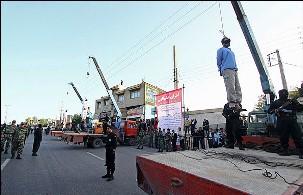
Drug traffickers after being executed in Iran

May 5, 2008: Iran has hanged 12 convicted criminals, including nine drug traffickers and three rapists, the latest in a growing number of executions in the Islamic republic, reports said. Nine drug traffickers were hanged, one of them in public, in the northeastern city of Bojnourd, Kayhan newspaper reported, without giving the date of the executions. This appears to be the first report of a public execution in Iran since judiciary chief Ayatollah Mahmoud Hashemi Shahroudi ordered in January that there should be no more public executions without his approval. "One person was hanged in public," said Kayhan, without giving further details. Shahroudi's decree came after a growing number of public executions in Iran, including the hanging of two convicted murderers in the centre of Tehran. It was not clear if he had approved the reported public execution in Bojnourd. Meanwhile, three criminals convicted of kidnapping and raping at least 11 girls were sent to the gallows in the southwestern city of Ahvaz on May 3, the Quds newspaper reported.
--------------------------------------------------------------------------------

NORTH CAROLINA (USA). DEATH ROW INMATE WALKS FREE-129TH EXONERATION

May 2, 2008: The state of North Carolina dropped all charges against Levon Jones, and he was freed after spending 13 years on death row. U.S. District Court Judge Terrence Boyle overturned Jones's conviction two years ago, but he was held in prison awaiting a possible retrial until prosecutors announced that they were dismissing all charges. Judge Boyle criticized Jones's defense attorneys for "constitutionally deficient" performance, noting their failure to research the history and credibility of Lovely Lorden, the prosecution's star witness. The judge noted, "Given the weakness of the prosecution's case and its heavy reliance on the testimony of Lovely Lorden, there is a reasonable probability that, but for counsel's unprofessional errors, the result of the proceeding would have been different." In April, Jones's new defense team filed an affidavit in which Lorden said, "Much of what I testified to was simply not true." She also stated that a detective coached her on what to say. Additionally, she collected $4,000 from the governor's office for offering the clues that led to the arrest of Jones. Jones's retrial was set to begin May 12th, 2008. Duplin County District Attorney Dewey Hudson decided to ask the judge in the case to drop all charges. Jones was originally convicted of robbing and shooting a bootlegger named Leamon Grady. Levon Jones is the 129th inmate to be exonerated and freed from death row since 1973. He is the 8th such inmate freed from North Carolina, and the 6th person in the country exonerated in the past 12 months.
--------------------------------------------------------------------------------

DRC. FIGHTING TO ESTABLISH THE UNCONSTITUTIONALITY OF THE DEATH PENALTY

Liévin N'Gondji

May 1, 2008: ongoing penal code reform in the Democratic Republic of Congo is giving abolitionists the chance to have the death penalty recognised as unconstitutional. The current Democratic Republic of Congo constitution, in place since early 2006, recognises the "right to life" and the "inviolable nature of human beings". A proposition for an article explicitly abolishing the death penalty was rejected by the national parliament during the text's elaboration in 2005. "We have submitted two requests, one to the director of public prosecutions' office and a second to the Ministry of Justice" to formally establish the unconstitutionality of the death penalty, explains Liévin N'Gondji, a lawyer and president of Culture for Peace and Justice (CPJ), member of the World and Congolese Coalitions against the death penalty. Thanks to international aid, the DRC's judicial system is being reformed and donors financing the project have invited CPJ to participate in the joint justice Commission, principally responsible for revising the penal code. N'Gondji estimates that "approximately three quarters of those present were in agreement" with his position on the unconstitutionality of capital punishment. According to N'Gondji, the Commission will make its recommendations to the government by the end of May. The latter should then make a decision quickly. "The next three months will be crucial", he believes.
--------------------------------------------------------------------------------

SAUDI ARABIA. 3 PAKISTANIS EXECUTED FOR HASHISH SMUGGLING

May 1, 2008: Zargar Sadajan, Roajan Sodajar, and Naik Mohammed Malak Mohammed, all Pakistanis, were executed in Riyadh, Saudi Arabia, after being convicted of receiving large quantities of hashish. A statement released by the Saudi Interior Ministry confirmed that the men were convicted by the court, and the verdict was approved by the Cassation Court and the Supreme Judicial Council.

Syndicate content

Articles from older Chronicle editions
may be found using our search page.